
Inspect Pawnee County's Current Owner
The Appraiser card's ownership panel is labeled "OWNER NAME AND MAILING ADDRESS." A separate situs panel covers the land's location. Read both alongside the PIN, Quick Ref, tax year, legal description, acreage, classification, sales rows, and "As of" time.
| Owner of record | Tax-roll party named on the parcel card |
|---|---|
| Owner styling | Initials, trust terms, or entity suffixes |
| Mailing address | Destination for official owner correspondence |
| Situs address | Location assigned to the parcel itself |
| PIN and legal description | Keys that distinguish the land |
| Sales reference | Date, book, and page lead for a deed |
An owner of record is not always an occupant. The mailing address routes notices, and it does not prove where anyone actually lives.
Check the Pawnee Owner Panel
The 2026 Pawnee parcel card shows a trust-style current owner, mailing route, rural situs, annual values, permits, appeals, and sales references. Every panel sits where a searcher expects it.
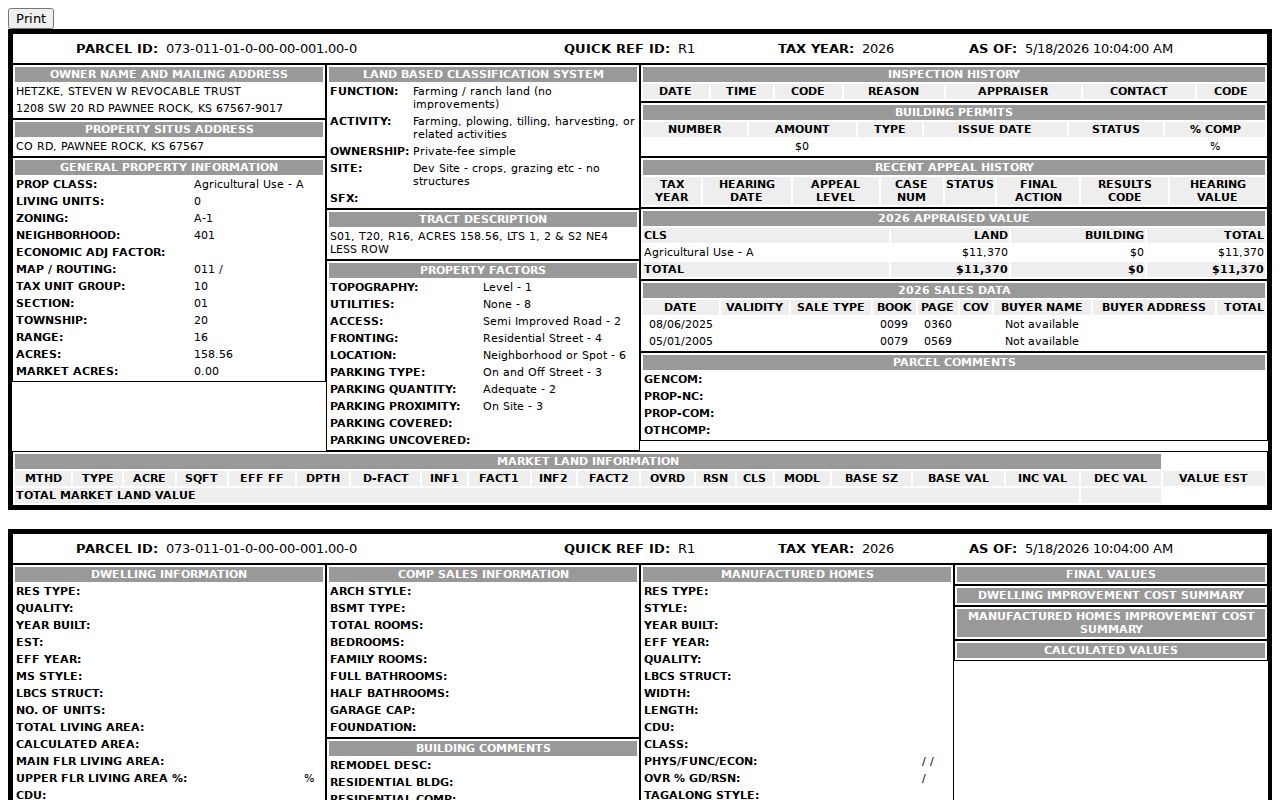
Note: The card is one example of field placement, so save it with its date rather than reading it as evidence about any other parcel.
Date Pawnee Owner Information
The gateway shows a database-update stamp that changes. Each card carries its own "As of" time. Neither one is a deed-recording timestamp. Pawnee County posts no set closing-to-roll lag. A deed can therefore be newer than the current owner field.
Annual valuation uses January 1, and real property is reinspected on a six-year cycle. Those appraisal dates say nothing about title freshness, so keep them only as context.
Confirm Pawnee's Owner of Record
Verification joins the tax record to the legal conveyance. The Pawnee Register of Deeds publishes no online index, so the last step is a staff request.
- Continue as a public user in the Appraiser portal and open the card.
- Copy the exact owner styling, PIN, legal description, and newest sales book/page.
- Request the latest deed by email, phone, fax, mail, or courthouse counter.
- Compare the deed's grantee and vesting language with the roll.
- Owner of record
- The party named on an official roll or instrument.
- Vesting
- The legal form in which title is held.
- Registered agent
- An entity's legal contact, not necessarily its owner.
Request Pawnee's Newest Deed
County land records run from 1874 to present. Even so, the Register of Deeds states plainly that no records are online. E-file is unavailable. Staff may email a small batch when time permits. The requester pays an invoice, and the office performs no title research.
Give staff the details. Owner names and year range help when known. Instrument type, PIN, full legal description, and book/page do too. Ask about the current cost and whether a plain or certified copy is needed.
Verify Pawnee Trust Ownership
The sample card's revocable-trust styling shows why every suffix and initial matters. Never substitute a trustee, beneficiary, signer, or personal representative for the vested trust. The deed or probate file must support that step first.
For an LLC or corporation, the Kansas entity search checks names and business IDs. It also shows current resident agents and filed records. It clarifies identity. It does not prove current parcel ownership.
Separate Pawnee Owner Addresses
A rural county-road situs can differ from the full owner mailing route. Postal place names deliver mail. They do not establish city limits. Match the PIN and legal description. Then inspect GIS MunicipalBoundary, Township, and Section layers when jurisdiction matters.
A mismatched pair does not make the current owner wrong. It usually reflects the land's situs. That is split from the place where tax mail goes.
Test Pawnee Sales References
The card showed sales dates and book/page references. Buyer names and a visible price were missing from that view. Treat the row as a retrieval lead. Hand the newest book and page to the Register of Deeds, then compare the instrument's legal description against the parcel.
If the deed names another tract, go back to the PIN. A split, replat, or similar street label can defeat an address-only match. Check the validity mark and the conveyance type shown. A row can document appraisal history without displaying every fact needed to establish current ownership.
Cross-Check Pawnee Parcel Identity
The ArcGIS parcel service exposes PIN, situs, owner, acreage, and township and range. It also links to annual property record cards. Use that data to confirm the current owner card. Check that the mapped tract shares one identifier. The PRC links run from 2018 through 2026. They can show when a tax-roll name or classification changed. The layer supplies no complete deed history, so treat it as one piece of the puzzle.
For rural land, compare section, township, range, acres, and any less-right-of-way clause. Town parcels differ. Preserve the addition, lot, and block. GIS is a cross-check, not a source of legal vesting or surveyed boundaries.
Resolve Recent Pawnee Ownership
When a card and deed disagree, compare dates. The roll may still name the former tax owner. A just-recorded conveyance is stronger transfer evidence. Ask the Appraiser whether an update is pending, and keep copies of both findings.
Pawnee District Court probate records can explain an estate transfer. Still, a will or court case alone does not prove that a new current owner received recorded title.
A sheriff's deed, quitclaim deed, or estate-administration deed can change the vested party without resembling a routine purchase. Preserve the exact instrument type. Never fill missing buyer or price details from assumptions or an unrelated notice. The 2025 tax-foreclosure notice is one example. It offers useful parcel and addition clues but does not show the final current owner of every listed tract.
Use Pawnee Owner Data Lawfully
A public mailing address can support a good-faith inquiry about a property. It is never a license to visit or pressure the owner of record. Kansas Safe at Home addresses, sealed files, and protected identifiers must stay protected, and no one should try to reconstruct or republish them from Pawnee County property records.
Lawful use. Current owner records support title checks, purchase diligence, estate work, and boundary questions. They must never be used to harass or target a person.
The owner card is not a title opinion. Treat it as a starting point, not a final word on ownership. For any material decision, verify details with the Pawnee County custodian. Qualified counsel can help when needed. When the online route stalls, go straight to the offices. The Appraiser can supply the property record card. The Register of Deeds holds the recorded deed and deed records for the parcel. A KORA request covers non-exempt county material that the routine channel does not provide. State the record wanted, the preferred format, any parcel identifiers, and a narrow date range. Kansas agencies may charge actual costs and may withhold exempt portions. A tight request is faster to answer and less likely to sweep in unrelated personal data.