
Trace Pawnee County Former Owners
Deeds build the legal chain, and historical sources fill the gaps. Because Pawnee County's collection is offline, exact notes on book, page, name, year, and land description make every request count.
| Source | Years It Covers | Where Held | What It Shows |
|---|---|---|---|
| Register of Deeds books | 1874-present | Pawnee County Courthouse | Grantors, grantees, instruments, and legal descriptions |
| KSHS deed microfilm | 1943-1990 | Kansas Historical Society | Indexes and deeds on 11 rolls |
| Historic atlases | 1902 and circa 1916 | Kansas Memory | Owner-name map snapshots and plats |
| Probate and newspapers | Probate 1872-present; papers vary | District Court and local archives | Estate authority, notices, and identity clues |
An atlas entry only hints; the recorded deed proves the link.
Reconstruct Pawnee Deeds Backward
Pawnee County posts no online grantor-grantee index. Every step therefore rests on a focused request to the office and on notes that preserve the exact land description.
- Find the current owner's acquiring deed and verify its legal description.
- Record the grantor as the first prior-owner lead.
- Find that grantor's earlier acquiring entry as grantee.
- Repeat while copying each date, deed type, book, and page.
- Grantor and grantee
- The party giving and the party receiving an interest.
- Chain of title
- The ordered sequence of instruments affecting the same land.
- Reverse index
- An index used to follow names backward through transfers.
- Quitclaim and warranty deed
- Conveyance forms that make different promises about title.
Bridge Pawnee's Microfilm Years
The KSHS Pawnee deed finding aid spans 1943 to 1990 on eleven rolls, AR5501 through AR5511.
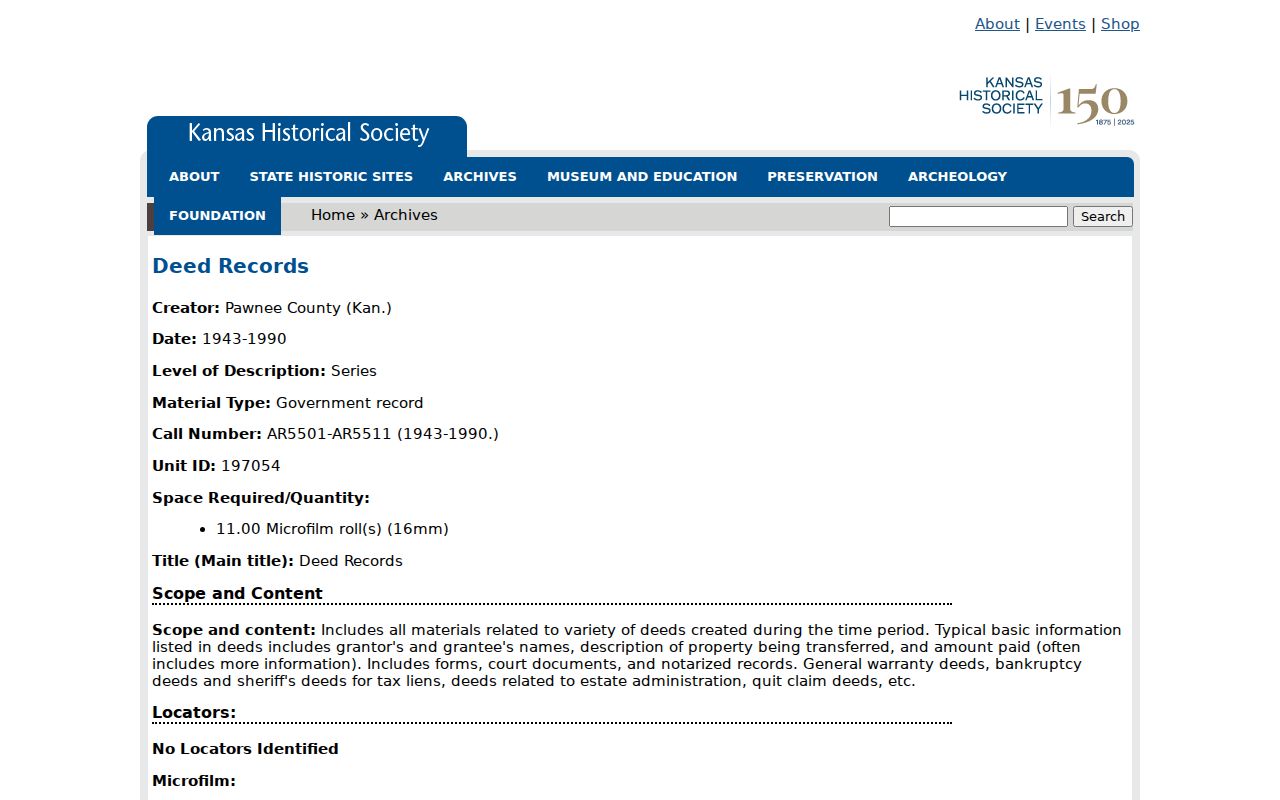
Warranty, quitclaim, bankruptcy, estate-administration, and sheriff's tax-lien deeds may all surface in these volumes. Log the roll and volume with each former owner.
Question Pawnee Volume Sixty
One catalog detail deserves a question. KSHS describes roll AR5508 with volumes 59 and 61, covering 1976 through 1979. Volume 60 never appears in that entry. A skip is not proof of destroyed records. The volume may sit unused, be held elsewhere, or simply be missing from the finding aid, so ask the archive; likelier causes are offline access, catalog error, a legal-description change, or probate.
Reach Pawnee's 1874 Start
Pawnee County land records run from 1874. They continue to the present, but nothing deed-related is online, so there is no digital cutoff year for the index or images. For 1874 through 1942, start with the county books. Then check KSHS and other archive catalogs, collection by collection. The Register of Deeds may email a small number of pages as staff time allows, invoicing the requester. Phone, fax, mail, and counter service also work. Staff will not rebuild the chain for you.
Map Pawnee Prior Owners
The 1902 Pawnee County atlas pairs township owner maps with town plats and a patrons' directory. A circa 1916 atlas carries the owner-name mapping further. Each page is a snapshot. Place names shift too. Brown's Grove became Burdette, then Burdett, and early Larned work may call for Original Townsite, Toles and Adams, Adams Addition, or Palmer's Addition, so match every old name to the recorded legal description.
Follow Pawnee Estate Owners
Probate files at Pawnee District Court begin in 1872. They can hold wills, inventories, sale orders, and land descriptions. Those documents show who held authority over an estate. Probate alone still proves no recorded transfer. Next, hunt an executor, administrator, heir, sheriff, or trust deed. Newspapers at Jordaan Memorial Library and the Santa Fe Trail Center supply notices and identity clues. But every clue must return to the deed books.
Track Pawnee Parcel Changes
A PIN can change after a split or replat. Town parcels ride on addition, lot, and block. Rural tracts use section, township, range, acreage, and exceptions like less right-of-way. The legal description bridges owners best. Never carry a name across a changed description without checking the land. An atlas label or postal city is context, not proof title moved. County GIS helps compare a current polygon against township, section, lot, block, and road layers, but a mapped edge is neither a survey nor a deed.
Request Pawnee Chain Pages
A strong Register of Deeds request names the apparent current and prior owners, the property address, the PIN or Quick Ref, the instrument type, and any known book and page. Add the full legal description and target years. Say which pages you need, index or deed. The county's Family Property History form adds requestor contact fields, owner and year, address, legal description, and other details. The form warns against selling or using lists of names and addresses to solicit property or services. It promises no fixed turnaround. Ask for an estimate and invoice. Staff fit small history work around office duties. A tight request respects that limit and leaves a clear record of which years were actually checked.
Read Pawnee Deed Variants
Not every exit was a warranty deed. The KSHS finding aid names general warranty, bankruptcy, sheriff's tax-lien, estate-administration, and quitclaim instruments. Mortgages, releases, liens, plats, powers of attorney, and court orders may explain events between conveyances. None of those names a new vested owner. Copy each document label exactly. A quitclaim conveys whatever interest the grantor held, without a warranty deed's title promises. A sheriff's deed can follow foreclosure or tax-sale proceedings. Compare the described land and recording references before adding any name to the former-owner timeline.
Measure Pawnee Former-Owner Depth
The practical trail runs deep. Probate and court files reach back to 1872, county land records to 1874, atlases to 1902 and circa 1916, and deed microfilm from 1943 to 1990. Federal-era land questions may need state tract-book guidance. Treat every coverage date as a starting point, not proof that each page survives or is indexed.
Lawful use. Former-owner research supports house history, estate work, and title diligence. Never use old or current addresses to track or harass a living person.
A timeline of past owners is only research evidence. It is not a title opinion. Take any material conclusion to the county custodian and a qualified title professional. Do this before acting on it.
Historical context can deepen a chain note, though it never replaces one. Pawnee County was organized in 1872. Local land records begin in 1874, and newspaper evidence starts in 1878. Those dates tell you where to look. They matter when a deed points to an older estate, townsite, or legal notice. Two archives hold useful material. Santa Fe Trail Center collections include land grants, directories, county record groups, and personal-property statements. Jordaan Memorial Library keeps long runs of the Larned and Burdett papers. When contacting either archive, include the town, exact legal description, owner name, estimated years, and the source already checked. Say whether you want a scan or a citation.