
What Pawnee Deed Records Contain
Deeds are only the start of what the Register of Deeds records. The office also holds mortgages and oil and gas leases. It keeps city and town plats, UCC security instruments, federal and state tax liens, and powers of attorney, along with other statutory filings. A thorough land inquiry therefore looks past the transfer itself. Related items tied to the same legal description matter. They can shape ownership just as much as the deed.
| Deed or instrument | What it records | Typical research use |
|---|---|---|
| Warranty deed | A conveyance carrying stated warranties | Follow an ordinary purchase |
| Quitclaim deed | Whatever interest the grantor conveys | Trace family or corrective changes |
| Trust or estate deed | A fiduciary transfer | Connect trust or probate ownership |
| Sheriff's deed | A court or tax-sale conveyance | Follow a distressed-property chain |
| Plat or vacation | A mapped lot, block, addition, or street action | Interpret the land description |
Labels matter in deed records. A sheriff's deed tells a different story than a private warranty deed, and a quitclaim never promises that every title defect was cured. Read the full image and its references.
Pawnee Deed Index Is Offline
The Pawnee County Register of Deeds offers no e-filing and no online records. There is no grantor-grantee form, no downloadable index, and no deed-image viewer for the public. County land records run from 1874 to the present, but reaching them means working through the office's index, books, images, and copy process.
Requests can go by counter, email, phone, fax, or mail. The office sits at 715 Broadway, second floor, Larned, Kansas 67550, open 8:30 a.m. to 5:00 p.m. weekdays. Documents are due before 4:30 p.m. Call 620-285-3276 or email joel.davis@pawneecountyks.org. Staff may email a small set of pages or deeds when time permits, and the requester pays an invoice.
Make the request narrow. Give names, a date range, legal description, document type, and book/page whenever known.
Walk Pawnee Grantors Backward
A grantor gives up an interest. A grantee takes it on. Start from the newest grantee you can confirm and pull that deed. The grantor named there becomes your next search backward, repeated while the same land description matches at every step of the deed chain.
- Copy the current owner styling, legal description, and newest sales book/page from the parcel card.
- Ask the Register of Deeds for the indexed instrument at that book and page.
- Record its parties, recording date, deed type, and prior reference.
- Search the grantor as an earlier grantee, rejecting namesakes with the legal description.
- Repeat until the target year, subdivision origin, or 1874 starting point.
- Chain of title
- The linked sequence of instruments affecting ownership.
- Book and page
- The local volume and page retrieval reference.
- Instrument number
- A separate recording identifier when used.
- Reverse index
- An index that helps follow a party in the opposite direction.
Names shift while the land does not. Trust suffixes, initials, estate roles, and business names can all change across decades, so names alone make weak joins.
Use Pawnee Parcel Leads
The public ATCi parcel card can surface sales dates and book/page references. One example points to Book 0099 Page 0360 for a 2025 row. Another cites Book 0079 Page 0569 for a 2005 row. Buyer names appear unavailable. No public price shows. So treat these as leads, not deeds.
Carry the PIN and legal description along. A PIN can change after a split or replat. But the description inside the instrument gives the durable land link. The Pawnee County property search supplies these starter fields.
Note: A blank tax-card field does not prove the recorded instrument lacks a buyer name or consideration.
Pawnee Microfilm Bridges Generations
The Kansas Historical Society finding aid lists Pawnee County deed records from 1943 through 1990. They sit on 11 rolls, AR5501 through AR5511. Warranty, quitclaim, sheriff, administrator, executor, mineral, and other deed types fill the set. It is an archive route, not an online owner search.
The volume sequence jumps from 59 to 61. Ask whether volume 60 went unused, sits elsewhere, or was omitted. Do not assume no deeds exist. For older or later years, return to the county books. KSHS tract books and federal land files are searched by legal description. The description leans on section, township, and range. The finding aid carries the official roll listing.
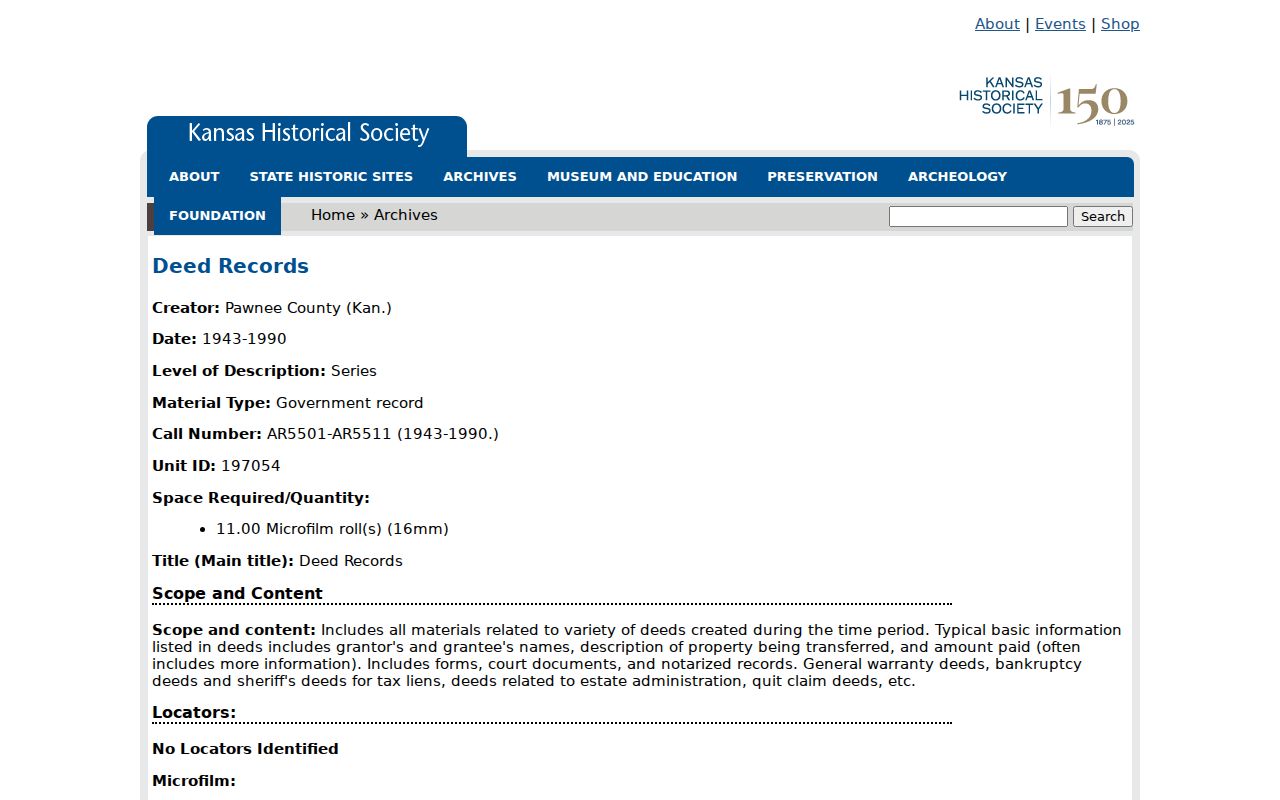
Its precise dates and roll numbers build a reliable bridge across the mid-to-late twentieth-century chain of title.
Historic Pawnee Plats Add Context
Kansas Memory's 1902 county atlas offers township landowner maps, a patrons' directory, and town plats. A circa 1916 atlas adds owner-name plats and roads. Neither is a conveyance. Yet both can yield a former owner's spelling, an old town name, a road clue, or an addition to carry into the deed index.
Larned's 2025 tax-sale notice names Toles and Adams Addition, Adams Addition, Palmer's Addition, and Original Townsite. Burdett records may say Brown's Grove, Burdette, or Burdett. Put exact historic place names in the search log.
Pawnee Liens Follow the Land
Mortgages, assignments, releases, mechanic's liens, tax liens, lis pendens, easements, and oil and gas leases can sit beside the deed chain. Pawnee County records hold them all. Search each by party, date, description, and prior book/page. An old mortgage is not necessarily open. Look for a release tied to the same borrower, lender, land, and original reference.
Court files may matter too. Foreclosure, quiet-title, partition, and lien cases can produce judgments and sale orders. The recorded sheriff's deed or release remains the land instrument. A public notice describes a process. It does not identify the owner of record.
Note: GIS roads and parcel lines can raise an easement question. Recorded documents and a survey resolve the evidence.
Search Pawnee Deed Office Fields
Pawnee County has no online deed-search screen. The search-field inventory belongs in the request itself. A grantor name is the practical key for moving backward from a seller. A grantee name follows the receiving party forward. Document type and recording year narrow crowded name runs. Book/page or a legal description can point staff straight to a known item. Ask whether the office also uses an instrument or reference number for the period involved.
| Office search key | How to provide it | Why it helps |
|---|---|---|
| Grantor | Exact surname-first or entity styling, with variants | Moves backward through prior transfers |
| Grantee | Buyer, trust, estate, or business name | Finds the receiving side of a deed |
| Document type | Deed, mortgage, lien, plat, release, or sheriff's deed | Separates instruments filed under the same party |
| Date range | Recording year or a bounded span | Reduces the index and volume search |
| Book and page | Copy exactly, including leading zeroes | Provides the local retrieval reference |
| Legal description | Addition, lot, block, or section-township-range | Confirms that a common name concerns the right land |
A parcel number helps when you cross-check a file. But it cannot substitute for the legal description. Narrower instruments are the reason. A road vacation, partial release, or mineral deed may touch only one slice of a tract. So spell out that limited scope when you write to the office. If the clerk hands you an index page, keep the neighboring entries too. Assignments and releases tend to arrive in linked sets. All of them point to the same book, page, parties, or description.
Compare Pawnee Index and Copies
An index entry and a deed copy answer different questions. The index is a finding aid. It lists parties, instrument type, recording date, book and page. The legal description and any related reference appear there too. The image itself is where you find granting language, signatures, acknowledgments, reservations, and attachments. A certified copy carries the custodian's stamp. A plain scan usually serves family or house-history work well enough.
Pull connected instruments whenever the first deed opens a new lead. A description citing a recorded plat means you need that plat. A conveyance subject to an easement means you need the easement. Pair a mortgage with its later release or assignment when current status matters. An executor's or administrator's deed can point toward the District Court probate file. A sheriff's deed may lead back to the sale order and its confirmation.
Pawnee County keeps its court and deed systems apart. Kansas eCourt can surface public case information. Image access depends on each court's adoption and access rules. The courthouse terminal and the clerk are the fallback. For the final recorded land instrument, the Register of Deeds remains the source. Match case number, recording date, party names, and legal description across both records. That keeps a judgment and a deed aligned without treating them as one event.
Hard-to-read scans happen. Ask the office whether a clearer image or a certified copy exists. Keep page margins, stamps, and attachments intact, since those details often hold recording references.
Order a Pawnee Deed Copy
Say plainly whether you want a plain copy or a certified one. Include grantor, grantee, deed type, year, book and page, legal description, and any instrument number. The county's Family Property History form gathers contact details, owner and year, address, legal description, and signature.
No current fee schedule or turnaround time is published. Ask for a price estimate and a completion date. Treat older fee figures as outdated. Staff fills history requests as time permits, and the office does not run title searches.
Recording is not a title opinion. Public recording gives notice, but it does not guarantee clear title or reveal every unrecorded claim.